Category: Government Jobs

  • RRC Western Railway Apprentice 2023 : Apply Exclusive 3624 Posts

    RRC Western Railway Apprentice 2023 : Apply Exclusive 3624 Posts

    RRC Western Railway Apprentice Recruitment 2023 : Apply Exclusive 3624 Posts

    June 24, 2023

    Post Date of RRC Western Railway Apprentice 2023: 22-06-2023

    Total Vacancy of RRC Western Railway Apprentice 2023 : 3624

    Brief Information:-

    RRC Western Railway Apprentice, Mumbai has recently released a notification inviting applications for Apprentice vacancies under the Apprentice Act 1961. The recruitment drive is aimed at filling positions in various Divisions and Workshops falling within the jurisdiction of Western Railway for the year 2023-2024. RRC Western Railway Apprentice 2023

    Prospective candidates who possess a keen interest in the particulars of the vacant position and satisfy the prescribed qualifications are strongly advised to diligently peruse the official notification. The document encompasses vital details pertaining to the extant positions, requisite qualifications, age threshold, process of selection, and modus operandi for application submission.

    In order to be considered for the available Apprentice positions, prospective candidates must adhere to the requirement of submitting their applications through the online platform. The digital application procedure facilitates the input of candidates’ personal particulars, scholastic achievements, and pertinent data. It is of utmost significance to ascertain that the entirety of the information proffered is both precise and comprehensive.

    RRC Western Railway Apprentice 2023 Interested candidates are advised to regularly check the official website of Western Railway, Mumbai for updates and notifications regarding the recruitment process. The website will provide further details on important dates, such as the opening and closing dates for online applications, as well as any additional requirements or documents that need to be submitted.

    RRC Western Railway Apprentice 2023 recruitment drive presents a valuable opportunity for individuals seeking apprenticeship positions within Western Railway, Mumbai. Candidates who fulfill the eligibility criteria and successfully complete the application process will have a chance to contribute to the railway sector and gain valuable experience in their chosen field.

    RRC Western Railway Apprentice Apply Online Form

    Prospective applicants for the esteemed RRC Western Railway Apprentice Recruitment 2023 are cordially invited to submit their applications for the impressive tally of 3624 available positions. The online application portal shall be accessible commencing from the auspicious date of 27 June 2023. Prospective and qualified individuals are cordially invited to tender their applications commencing on the auspicious date of June 27th, 2023. The final deadline for the completion of the application process is set for the 26th of July in the year 2023. The provided hyperlink for accessing the online application portal for the RRC Western Railway Apprentice program in the year 2023 is presented herewith.

    Click here for Apply RRC Western Online 2023


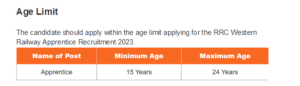
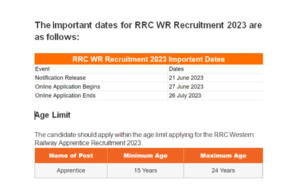
    The candidate should apply within the age limit applying for the RRC Western Railway Apprentice Recruitment 2023.

    RRC WR Recruitment 2023 Application Fees

    Educational Qualification


    Important Links
    Apply online Available on 27-06-2023
    Notification Click Here
    official Website Click Here


    Social Media Links
    Whatsaap Channel Click Here
    Face book Channel Click Here
    Telegram Channel Click Here

    Here Are Some FAQ :-

    Q1: What is the Advt No. 01/2023 for RRC, Western Railway Apprentice Vacancy 2023?

    A1: Advt No. 01/2023 refers to the advertisement number for the Apprentice Vacancy recruitment conducted by the Railway Recruitment Cell (RRC) of Western Railway for the year 2023.

    Q2: To apply for the RRC, Western Railway Apprentice Vacancy 2023, How much is the application fee?

    A2: As part of the online application procedure, applicants must submit a non-refundable application fee of Rs. 100/-. The charge is payable via the internet.


    Q3: Are there any candidates exempted from paying the application fee for RRC, Western Railway Apprentice Vacancy 2023?

    A3: Yes, there is no application fee for candidates belonging to SC/ST/PWD/Women categories. They are exempted from paying the fee.

    Q4: What are the important dates for RRC, Western Railway Apprentice Vacancy 2023?

    A4: The important dates for the recruitment are as follows:

    • Starting Date to Apply Online: 27-06-2023 at 11:00 Hrs
    • Closing Date to Apply Online: 26-07-2023 at 17:00 Hrs

    Q5: What is the age limit for RRC, Western Railway Apprentice Vacancy 2023?

    A5: As of 26-07-2023, the age limit for candidates applying for the Apprentice Vacancy is as follows:

    • Minimum Age: 15 Years
    • Maximum Age: 24 Years Age relaxation is applicable as per the rules.

    Kindly be advised that the following frequently asked questions offer a comprehensive overview, albeit in a general sense. For precise and meticulous details pertaining to the RRC, Western Railway Apprentice Vacancy 2023, it is highly recommended to consult the official notification.


    RRC- North Eastern Railway Act Apprentice Recruitment 2023 – Apply Online for Vibrant 1104 Posts


  • Government Jobs: Lucrative Opportunity

    Government Jobs: Lucrative Opportunity

    Government Jobs : Lucrative Opportunity 

    Government jobs include positions in various branches and levels of government, such as municipal, state, and federal agencies. These jobs are usually governed by the government entity’s specific laws, regulations, and hiring processes.


    Government jobs provide various advantages, including job security, competitive pay, complete benefit packages, retirement programs, and prospects for growth. These occupations are broad and cover a wide range of areas, including administration, law enforcement, education, healthcare, engineering, finance, research, and others.


    To pursue government jobs, individuals must normally meet particular standards, which may include educational qualifications, relevant work experience, and, in some cases, specific certificates or licenses. The hiring process for government jobs frequently includes a demanding application and selection procedure that may include written exams, interviews, background checks, and medical evaluations.


    Government job openings are often publicized on official government websites, job boards, and in the media. Individuals who are interested can access these platforms, check the job descriptions, and submit their applications according to the standards and deadlines.


    It should be noted that government jobs availability, qualifications, and application procedures may differ between countries and areas. As a result, it’s critical to conduct research and consult official government sources for reliable and up-to-date information about government job prospects in a certain place.


    Which government position is better for women?

    There are several government jobs acceptable for women, and the choice ultimately depends on individual interests, credentials, and professional ambitions. Here are some government jobs that are popular among women:


    1. Education: Teaching employment at government schools, colleges, and universities is a popular choice for women. These positions might range from elementary school teachers to professors at higher education institutes.

    2. Healthcare: Government hospitals, clinics, and healthcare divisions provide a wide range of career options for women. They can work as doctors, nurses, pharmacists, laboratory technicians, or in administration.

    3. Public Services: Many women aim to enter the public service and work in administrative jobs inside the government. This comprises posts in the Indian Administrative Service (IAS), the Indian Police Service (IPS), and other national and state government administrative services.

    4. Banking and Finance: Government banks, financial institutions, and regulatory agencies provide chances for women to work in fields such as banking, finance, accounting, and auditing.

    5. Defense Services: Women are increasingly joining the armed forces in numerous countries. Opportunities include entering the military, navy, air force, or paramilitary forces in positions such as officers, pilots, engineers, or administrators.

    6. Social Services: Government departments that focus on social welfare, women’s empowerment, child development, and family services frequently offer positions that cater to women. These positions entail addressing social issues, providing support services, and implementing government programs.

    7. Research and Development: Women can work in research and development in government organizations, particularly in scientific research institutions, agricultural departments, environmental agencies, and technology-driven sectors.


    These are just a few examples; there are many more government career opportunities for women. When examining career alternatives, it is critical to examine personal interests, talents, and qualifications, as well as research specific work needs in each industry.


    What are the best government jobs and salaries in India?

    There are various famous government jobs in India that pay well. Salaries for government jobs can vary depending on criteria such as the position, amount of responsibility, experience, qualifications, and the government’s pay scales. Here are some of the most common government positions in India, along with their estimated income ranges:


    1. Indian Administrative Service (IAS) and Indian Police Service (IPS): As members of the civil service, these positions are highly esteemed and prominent. The pay scale established by the government governs the salaries of IAS and IPS personnel. Starting wages for entry-level officers (Assistant Commissioners of Police or Deputy Collectors) might range from roughly Rs. 56,100 to Rs. 77,000 per month. Officers’ pay rises dramatically as they advance through the ranks.


    2. Public Sector Banks and Financial Institutions: Positions at public sector banks, such as the State Bank of India (SBI), pay well. The salary for entry-level occupations might range from Rs. 25,000 to Rs. 35,000 per month. Employees’ wages rise as they gain expertise and advance in their careers.


    3. Defense Services: The Indian Army, Navy, and Air Force offer competitive salaries and extensive benefits. Salary levels vary according to rank and position. Starting wages for officers might range from Rs. 56,100 to Rs. 77,000 per month.


    4. Scientists and engineers in Research institutions: Government research institutions such as the Indian Space Research Organization (ISRO), the Defense Research and Development Organization (DRDO), and the Council of Scientific and Industrial Research (CSIR) pay well. Salaries are determined by experience, credentials, and work duties. A starting salary can range between Rs. 50,000 and Rs. 70,000 per month.


    5. Union Public Service Commission (UPSC) Jobs: Jobs gained through UPSC examinations, such as those in the Indian Revenue Service (IRS), Indian Foreign Service (IFS), and Indian Audit and Accounts Service (IAAS), pay well. Starting compensation for these services can range between Rs. 56,100 and Rs. 77,000 per month.


    6. Public Sector Undertakings (PSUs): PSUs in industries such as oil and gas (e.g., Oil and Natural Gas Corporation), power (e.g., NTPC Limited), and telecoms (e.g., Bharat Sanchar Nigam Limited) give competitive pay. Salaries might range from Rs. 40,000 to Rs. 80,000 per month, depending on the role and expertise.


    It’s crucial to note that these compensation ranges are estimates and can change depending on a variety of circumstances. Furthermore, government jobs frequently include additional advantages such as allowances, pension plans, medical benefits, and prospects for career advancement.


    Which is better: a government job or private employment?

    The decision between government jobs and a private job is based on personal preferences, professional ambitions, and personal circumstances. Both sorts of employment have perks and cons. When comparing government jobs and private occupations, keep the following aspects in mind:


    Benefits of a Government Job:

    1. Job Security: Government occupations are frequently regarded as more secure, with long-term career prospects and protection from arbitrary dismissal.
    2. Perks and Benefits: Government employment often includes comprehensive benefit packages that include health insurance, pension schemes, paid leave, and other allowances.
    3. Work-Life Balance: Government positions often provide a better work-life balance, with set working hours and specified leave rules.
    4. Stability and Retirement Benefits: Government employment frequently provides a secure and predictable career path with opportunities for advancement and retirement benefits.


    Private Job Advantages:

    1. Higher Salaries: Jobs in the private sector typically pay more and have the possibility of a quick wage rise, especially in fields with high demand or specialized skills.

    2. Advancement and Innovation: In the private sector, firms frequently stress innovation and technology, as well as possibilities for professional growth and skill development.

    3. Flexibility: Jobs in the private sector can provide more flexibility in terms of work schedule, location, and the ability to work remotely.

    4. Performance-Based Reward Systems: Private organizations frequently feature performance-based incentive systems, bonuses, and stock options for high-performing staff.


    In the end, the “better” work option is determined by individual priorities. Some people value work security and stability, which makes government jobs more enticing, whereas others value higher income and career advancement, which leads them to seek employment in the private sector.


    Consider personal interests, job happiness, work culture, growth potential, and the specific employment market conditions in your field of interest. Conducting careful research, assessing your goals and preferences, and weighing the advantages and cons of each employment type will help you make an informed selection.


    Which government examinations are the easiest to pass?

    The perceived difficulty of passing government tests can vary substantially based on individual aptitude, preparation, and the exact exam in issue. While categorizing tests as universally easy or difficult is subjective, below are a few government exams in India that are usually regarded as less difficult in comparison to others:


    1. Staff Selection Commission (SSC) Combined Higher Secondary Level (CHSL): The SSC holds this exam to fill various positions such as Lower Division Clerk (LDC), Data Entry Operator (DEO), and Postal/Sorting Assistant. It necessitates a basic command of English, mathematics, and general awareness.

    2. Railway Recruitment Board Non-Technical Popular Categories (NTPC): RRB NTPC test is used to fill numerous non-technical vacancies in the Indian Railways. The exam measures candidates’ knowledge of topics such as General Awareness, Mathematics, and Reasoning.

    3. State-Level Police Recruitment Boards (Constables): Many state police departments hold recruitment exams for the position of constable. These tests mainly assess candidates’ understanding of areas such as General Awareness, Reasoning, and Numerical Ability.

    4. State Public Service Commission (PSC) Clerk and Assistant Exams: State PSCs provide exams for posts such as clerks and assistants in various government ministries. These tests often include courses like General Knowledge, English, and Mathematics, and the level of difficulty varies depending on the state and syllabus.


    While these tests may be regarded as simpler by some, they nevertheless necessitate rigorous preparation and determination to succeed. The level of difficulty can change from year to year; therefore, it’s critical to grasp the exam schedule, curriculum, and scoring criteria in order to develop an effective study approach.


    Finally, the secret to passing any government jobs exam is regular preparation, understanding the exam format, practicing with previous year’s question papers, and being current with current events. For a greater chance of success, select exams that correspond to your hobbies, educational background, and job ambitions.
  • Indian Railway Jobs – Exclusive Recruitment Guide

    Indian Railway Jobs – Exclusive Recruitment Guide

    1. Indian Railway Jobs: A Guide for Graduates

    There are many reasons why someone might want to pursue a career in the railway industry. It can be an exciting and diverse industry to work in, with a wide range of job roles and opportunities available. It can also be a great way to learn new skills and gain experience in a variety of different areas.


    The Indian railway jobs offers a wide range of job roles for graduates. These include roles in engineering, operations, maintenance, customer service, and marketing. There are also opportunities to work in finance, HR, and IT.


    The Indian railway industry is a great place to start your career. It offers a wide range of job roles and opportunities, and is a great way to learn new skills and gain experience. If you’re thinking about a career in the railway industry, then this guide is for you.


    2. Indian Railway Jobs After Graduation: What You Need to Know

    The Indian railway workforce is one of the most important and essential in the country. It is responsible for the safe and efficient operation of the nation’s railways, ensuring that passengers and freight can travel safely and on time.


    There are many different types of jobs in the railway workforce, from train drivers and track workers to engineers and ticket inspectors. There are also many opportunities for graduates, who can use their skills and knowledge to help keep the railways running smoothly.

    If you’re interested in a career in the railway workforce, here are two jobs that you might want to consider:

    1. Train Driver

    As a train driver, you will be responsible for operating the train and making sure that it arrives at its destination safely and on time. You will need to have a good understanding of the railway network and be able to follow timetables and schedules. You will also need to be able to work well under pressure, as there can be delays and disruptions to the service.


    2. Engineer

    As an engineer, you will be responsible for maintaining and repairing the railway infrastructure, such as the track, signals and bridges. You will need to have a good understanding of how the railway system works and be able to use a variety of tools and equipment. You will also need to be able to work well under pressure, as there can be deadlines to meet.


    If you’re interested in a career in the railway workforce, then these two jobs are a great place to start. Train drivers and engineers are essential to the running of the railway network and there are many opportunities for graduates.


    3. Indian Railway Jobs for Girls: The Latest Opportunities

    The Indian railway jobs  offers a variety of different roles for women of all ages, backgrounds and experiences. Whether you’re looking for a challenging career or a more relaxed lifestyle, there’s a railway job to suit you.


    Here are just a few of the latest opportunities available for women in the indian railway jobs


    1. Train Driver

    One of the most popular roles for women in the railway industry is that of train driver. Train driving can be a very rewarding career, with the opportunity to travel the country and see some amazing scenery.

    If you’re interested in becoming a train driver, you’ll need to have a good level of fitness and be able to pass a medical examination. You’ll also need to be able to pass a criminal records check.


    2. Train Guard

    Another popular role for women in the railway industry is that of train guard. Train guards are responsible for the safety of passengers and train crew, and for the smooth running of the train service.

    If you’re interested in becoming a train guard, you’ll need to have a good level of fitness and be able to pass a medical examination. You’ll also need to be able to pass a criminal records check.


    3. Train cleaner

    A less well-known but equally important role in the railway industry is that of train cleaner. Train cleaners are responsible for keeping trains clean and tidy, and for ensuring that they are free from litter and graffiti.

    If you’re interested in becoming a train cleaner, you’ll need to have a good level of fitness and be able to pass a medical examination. You’ll also need to be able to pass a criminal records check.


    4. Latest Indian Railway Jobs: An Overview of the Current Opportunities

    The Indian Railway workforce is one of the most diverse in the world. It is also one of the most exciting, with a wide range of opportunities for those looking to make a difference.

    The Indian Railway jobs workforce is made up of a variety of different roles, from track workers and engineers, to ticket inspectors and station staff. There are also many opportunities for those with specialist skills, such as marketing and communications, or HR and finance.

    The Indian Railway is always looking for talented and ambitious people to join its ranks, so if you think you have what it takes, then why not explore the latest Railway jobs?

    Here are four of the latest Railway jobs that are currently available:


    1. Track Worker

    As a track worker, you will be responsible for maintaining and repairing the railway tracks. This is a vital role, as it helps to keep the trains running on time and to ensure the safety of passengers.

    2. Engineer

    As an engineer, you will be responsible for the design, construction and maintenance of the railway infrastructure. This is a highly skilled and technical role, so it is perfect for those with a background in engineering.

    3. Ticket Inspector

    As a ticket inspector, you will be responsible for checking passengers’ tickets and ensuring that they are valid. This is a critical role, as it helps to ensure that only those with a valid ticket can travel on the Railway.

    4. Station Staff

    As station staff, you will be responsible for assisting passengers with their enquiries, and for providing them with information about the Railway. This is a customer-facing role, so it is perfect for those with good customer service skills.

    If you are interested in any of these roles, then why not head to the Railway website and apply today

    Visit for more Job vacancies – Government Jobs | Central Government Jobs | Indian Post Office | Indian Civil Service Exams


  • Haryana Skill Development Mission : A Step Ahead

    Haryana Skill Development Mission : A Step Ahead

    Haryana Skill Development Mission

    Haryana Skill Development Mission (HSDM) is an effort launched by the Government of Haryana in India to improve the employability of the state’s youth by providing them with skill development opportunities. The project was initiated in 2015 with the goal of bridging the skills gap between youth and industry requirements.


    The Haryana Skill Development Mission collaborates with numerous government ministries, industry, and training partners to implement skill development programs throughout the state. Manufacturing, healthcare, tourism and hospitality, agriculture, construction, automobiles, and information technology are among the areas targeted by the mission.


    The Haryana Skill Development Mission primary goals are as follows:

    1. Skill Development: Providing skill training to youth in many industries to improve their employability and revenue generation potential.
    1. Industry Collaboration: Forming alliances with industries and employers to better understand their skill requirements and coordinating training programs accordingly.
    1. Infrastructure Development: Creating cutting-edge skill training infrastructure, such as skill development centers, training institutes, and vocational training labs.
    1. Trainers’ Training: Organizing programs to train trainers and instructors in order to assure quality skill development programs.
    1. Placement Support: Assisting skilled applicants in obtaining suitable work prospects through collaboration with industries and job fairs.
    1. Entrepreneurship Promotion: Encouraging and assisting adolescents in starting their own enterprises by providing required skills, mentorship, and access to financial resources.


    Haryana Skill Development Mission operates a network of skill development centers, ITIs (Industrial Training Institutes), and training partners throughout the state. The mission also operates several hallmark initiatives, including the Skill Sakhi Program, Skill-On-Wheels, Kaushal Mela, and the Recognition of Prior Learning (RPL) program.


    The Haryana Skill Development Mission activities aim to provide youngsters with industry-relevant skills, boost their employability, and contribute to the state’s overall economic growth.


    Who is the director of the Haryana Skill Development Mission?

    Mr. Devender Singh is the Director of Haryana Skill Development Mission (HSDM).


    What is the Surya scheme in Haryana?

    Surya is a flagship scheme of the Haryana Skill Development Mission for short-term skill trainings, training of trainers, up-skilling, and recognition of prior learning for Haryana’s youth, with 100% financial support provided by the Haryana government.


    What is the mission’s goal in terms of skill development?

    The fundamental goal of a skill development mission is to improve individuals’ employability and skill set in order to satisfy the needs of the labor market and contribute to the general economic growth of an area or country. The particular objectives may vary based on the setting and purpose of the mission, however some common objectives include:


    1. Bridging the Skill Gap: The mission is to close the skills gap between the workforce and the industry’s needs. The mission seeks to provide individuals with the skills needed to fulfill the needs of the job market by delivering relevant and industry-specific training.
    1. Promoting Employment: The mission focuses on boosting employment opportunities by increasing persons’ employability. This includes providing training in high-demand industries, developing job-oriented programs, and linking trained persons with work possibilities.
    1. Increasing Productivity: Skill Development Missions strive to increase labor productivity and efficiency by providing specialized skills and information. The mission contributes to the overall growth and competitiveness of industries and sectors by improving individuals’ skill sets.
    1. Promoting Inclusive Growth: Skill development missions frequently emphasise inclusion by giving training opportunities to excluded or disadvantaged groups such as youth, women, rural communities, and economically challenged portions of society. The goal is to ensure that skill development efforts serve all segments of society and contribute to the reduction of inequality.
    1. Encourage Entrepreneurship: Some skill development missions also focus on cultivating an entrepreneurial mindset and providing assistance to individuals who want to start their own firms. This goal seeks to foster self-employment, creativity, and job development in the community.
    1. Industry Collaboration: Skill development missions seek to form collaborations with companies, employers, and training providers in order to connect training programs with industry requirements. This collaboration guarantees that the skills being produced are relevant and in accordance with current market demands.


    Overall, the goal of a skill development mission is to provide individuals with the necessary skills, information, and resources to improve their employability, contribute to economic growth, and improve their overall livelihoods.

    Haryana skill development mission courses

    The Haryana Skill Development Mission (HSDM) provides a wide range of skill development courses in a variety of fields. These courses are aimed to provide learners with industry-relevant skills and increase their employability. While the precise courses offered may change over time, these are some examples of courses offered by HSDM:


    1. Retail Management: Courses focusing on retail operations, customer service, inventory management, visual merchandising, and sales strategies.
    1. Construction Skills: Courses in construction skills such as masonry, carpentry, plumbing, electrical work, and painting.
    1. Information Technology (IT) Skills: Courses in computer foundations, software development, web development, programming languages, database management, and networking.
    1. Hospitality and tourist Skills: Courses in hotel management, food and beverage services, front office operations, housekeeping, and travel and tourist management.
    1. Healthcare Skills: Courses in nursing aide, healthcare management, medical laboratory technology, patient care, and pharmacy assistant.
    1. Beauty and Wellness Skills: Courses in beauty treatment, hairdressing, makeup artistry, spa therapies, and salon management.
    1. Automotive Skills: Courses in automobile repair and maintenance, vehicle servicing, automotive painting, and auto-electrical systems.
    1. Agriculture and allied skills courses include gardening, organic farming, dairy farming, poultry farming, and animal husbandry.
    1. Entrepreneurship and Business Development: Courses that teach entrepreneurial skills, business planning, marketing tactics, financial management, and e-commerce.


    These are only a few examples; HSDM may offer additional courses. To obtain the most accurate and up-to-date information on the courses available, it is recommended that you visit the Haryana Skill Development Mission’s official website or contact them directly.


    Haryana Skill Development Mission Certificate

    Haryana Skill Development Mission (HSDM) awards certificates following successful completion of various skill development courses. These certificates aim to recognize the abilities obtained by individuals through the training programs. Certificates are often awarded to participants who have completed the course requirements and proven proficiency in the specified skill area.


    HSDM certificates include the course name, duration, and skills learned. They may also include essential information such as the participant’s name, unique identification numbers, and the HSDM emblem or logo. These credentials might be useful for persons seeking job because they confirm their abilities and expertise in a specific subject.


    It is crucial to note that the particular format and details specified on the certificates may change based on the course and HSDM standards.

    Click here for more jobs – Government Jobs | Central Government Jobs


    Haryana admission, skill development and industrial training department


    To apply for admission to the Haryana Skill Development Mission and Industrial Training Department of Haryana, please follow the general admission process stated below:

    1. Go to the Official Website: Visit the official website of the Haryana Skill Development and Industrial Training Department to learn more about the offered courses, admission requirements, and application process. The website may provide information regarding individual admission notices, application forms, and standards.
    1. Select a Course: Choose a course from the department’s list of skill development programs. Examine the qualifying criteria, course duration, and any other requirements listed for the chosen course.
    1. Verify Eligibility: Make sure you meet the eligibility conditions for the course you want to apply for. Educational standards, age limits, and other prerequisites may differ depending on the course.
    1. Fill out the Application Form: If an application form is accessible on the department’s website, download or fill it out online. Provide accurate and comprehensive information as requested, including personal data, educational background, and any other pertinent information.
    1. Submit Application: Submit the completed application form together with any relevant papers such as educational certificates, identity evidence, and pictures. Follow the submission instructions, whether online or offline.
    1. Selection Process: The department will evaluate applications and shortlist individuals based on the criteria provided. Depending on the course and the department’s policies, the selection procedure may include written tests, interviews, or merit-based selection.
    1. Admission Offer: If you are chosen, you will receive an admission offer from the Skill Development and Industrial Training Department. Follow the directions in the admission offer letter, such as paying the required fees and submitting any further documentation.


    It’s vital to remember that the admissions process varies depending on the course and the department’s policies. It is best to visit the department’s official website or contact them directly for the most accurate and up-to-date information on admissions to skill development and industrial training courses in Haryana.

    Click for more jobs – Haryana Kaushal Rozgar Nigam | Haryana Government Jobs


    For more interesting blogs Click Here

    To know RRB Mumbai

    To apply interesting jobs Click Here

    Reach out to official site

  • Rajasthan Public Service Commission : A Renowned Authority

    Rajasthan Public Service Commission : A Renowned Authority

    Rajasthan Public Service Commission

    Rajasthan Public Service Commission (RPSC) is a government institution in the Indian state of Rajasthan that is in charge of administering various recruitment exams and choosing candidates for civil service and other administrative positions in the state government. RPSC, established in 1949, is an autonomous organization that acts in accordance with the requirements of the Indian Constitution.

    Rajasthan Public Service Commission’s key responsibilities include:

    1. Organizing recruitment examinations: The Rajasthan Public Service Commission (RPSC) organizes competitive examinations to choose candidates for various positions in the state government, such as Rajasthan Administrative Service (RAS), Rajasthan Police Service (RPS), Rajasthan Taxation Service (RTS), and other administrative roles.
     
    1. Advising the state government: The RPSC advises the state government on topics pertaining to government employee recruitment, advancement, and disciplinary proceedings. It also makes suggestions on a variety of administrative and policy issues.
     
    1. Creating recruiting rules: The commission creates and revises recruitment regulations for various state government positions and services. It guarantees that the selection process is fair, transparent, and merit-based.
     
    1. Interviews and personality testing: For candidates who pass the written examinations, the RPSC conducts interviews and personality tests. These interviews determine the candidates’ suitability for the positions for which they have applied.
     
    1. Promotion of research and publications: The RPSC encourages research and publication activities relating to the recruiting process, administrative changes, and other pertinent topics. It strives to help the state establish a competent and effective administrative administration.
     

    Candidates interested in applying for RPSC posts should visit the commission’s official website to learn about the most recent notifications, examination schedules, application methods, and syllabus for various tests. It is critical to check the website for updates regularly and to follow the RPSC recommendations while applying for tests or other recruitment processes.

    Will there be RAS exam in 2023?

    Yes, the Rajasthan Administrative Service (RAS) test will be held in 2023; Rajasthan Public Service Commission RAS test 2023 is scheduled to take place in August 2023. I recommend visiting the Rajasthan Public Service Commission’s (RPSC) official website or monitoring the latest news and information regarding RAS examinations. The RPSC website will provide the most up-to-date information on the RAS test schedule, notifications, and other data. You should also consider contacting RPSC directly with any questions or clarifications.


    Who is eligible for RAS exam 2023?


    Eligibility criteria for the Rajasthan Administrative Service (RAS) exam are subject to change, so it is critical to refer to the official notification or website of the Rajasthan Public Service Commission (RPSC) for the most correct and up-to-date information. However, based on recent exam trends, I can supply you with the broad eligibility criteria. Please keep in mind that these criteria may vary depending on the category (general, reserved, etc.).

    The following is a broad overview of the RAS exam eligibility requirements:

    1. Nationality: Applicants must be Indian nationals.
    1. Age Limit: The minimum age limit is normally 21 years, and the maximum age limit is roughly 40 years (age relaxation may be applicable for specific groups based on government regulations).
    1. Educational Requirements: Candidates must hold a bachelor’s degree from a university recognized by the government. The particular educational qualifications for various positions within the RAS may change.
     

    It is crucial to note that the above criteria are intended to be a general guideline, and there may be additional prerequisites or particular credentials for certain RAS positions. When the RAS test 2023 is issued, it is best to check the official notification or the RPSC website for the most up-to-date and detailed eligibility criteria.

    Which is the upcoming exam of RPSC?

    Rajasthan Public Service Commission holds the following exams regularly:

    Rajasthan Administrative Service (RAS) test: RAS is a prominent test held by RPSC to hire candidates for administrative positions in the state government.


    Rajasthan Police Service (RPS) test: The RPSC administers this test to select candidates for various positions in the Rajasthan Police Service.


    Rajasthan Taxation Service (RTS) Exam: The Rajasthan Public Service Commission administers this exam to select applicants for vacancies in the Rajasthan Taxation Service.


    Rajasthan Judicial Service (RJS) Exam: The Rajasthan Public Service Commission administers this exam to choose applicants for the Rajasthan Judicial Service, which comprises positions in the judiciary.

    RPSC administers the School Lecturer Exam to select applicants for the position of Lecturer in several courses in government schools.


    Assistant Engineer (AE) test: The RPSC administers the AE test to select applicants for engineering positions in various state government departments.

    These are just a few examples; Rajasthan Public Service Commission also administers exams for many posts and services within the state government. It is recommended that you check the official RPSC website frequently for the most recent alerts and updates about future exams.

    Which posts are in RAS?

    The Rajasthan Administrative Service (RAS) is a famous exam administered by the Rajasthan Public Service Commission (RPSC) to hire candidates for administrative positions in the Rajasthan state government. The RAS test is held to fill a variety of positions in the state administrative services. Among the key positions covered by the RAS are:

    1. Deputy Collector: At the district level, a Deputy Collector is in charge of administrative and revenue-related responsibilities.
    1. Deputy Superintendent of Police (DSP): A DSP is in charge of keeping the peace, investigating crimes, and safeguarding public safety.
    1. Block Development Officer (BDO): A BDO is in charge of the overall development and administration of a particular block or area.
    1. Tehsildar: A Tehsildar is in charge of revenue administration in a Tehsil, including land records, taxation, and other related functions.
    1. District Supply Officer (DSO): A DSO is in charge of procuring and distributing critical commodities in the district.
    1. Assistant Commissioner (Commercial Taxes): An Assistant Commissioner of Commercial Taxes is responsible for the administration and enforcement of commercial tax rules and regulations.
    1. Superintendent, Jail: A Superintendent of Jail controls the administration and management of state institutions.
     

    These are some of the important positions that applicants can be appointed to through the RAS test. The particular number and nature of positions may change with each recruitment cycle, and additional positions may be added.

    click here for other state jobs – 

    Mizoram Jobs | Nagaland Jobs | Uttarakhand Jobs | Rajasthan Police Constable Vacancy


    What is the interview marks for RAS exam?

    The interview stage of the Rajasthan Administrative Service (RAS) test is worth a maximum of 100 points and is administered by the Rajasthan Public Service Commission (RPSC).

    The RAS exam concludes with an interview, sometimes known as a personality test. Its purpose is to evaluate the candidate’s suitability, expertise, personality qualities, communication abilities, and overall awareness of numerous issues. The interview panel is made up of professionals and government officials who assess candidates based on their performance during the interview.

    To calculate the final merit list and ranking of candidates, the marks received during the interview stage are added to the marks obtained during the written examination. The weightage allocated to interview marks varies from year to year and is usually stated in the official notification or exam instructions issued by RPSC for that particular test cycle.

    It should be noted that particular information about the interview marks, such as the evaluation methodology and the allocation of marks for certain areas, are subject to change. For the most current and up-to-date information on the RAS interview marks, it is best to consult the official RPSC website or the most recent announcement.

    What is the purpose of Rajasthan Public Service Commission?

    The Rajasthan Public Service Commission (RPSC) exists to serve as an autonomous government institution in charge of conducting recruitment examinations and choosing candidates for various administrative jobs and services in the state government of Rajasthan, India. RPSC’s key goals are as follows:

    1. Recruitment: The RPSC is primarily responsible for conducting competitive tests to select qualified applicants for a variety of government positions. This comprises jobs in administrative services, police services, taxation services, engineering services, educational services, and other government sectors.
    1. Selection Process: The RPSC guarantees that the selection process for government positions is fair, transparent, and based on merit. The commission conducts written exams, interviews, and personality tests to assess candidates’ knowledge, abilities, aptitude, and eligibility for various posts.
    1. Recommendations and Advice: The RPSC makes recommendations and offers advice to the state government on topics relating to government employee recruitment, advancement, and disciplinary proceedings. The commission contributes to the development of recruitment regulations, policies, and procedures to improve the efficiency of government departments.
    1. Administrative Reforms: The RPSC contributes to administrative reforms by conducting research, promoting publications, and providing insight on a variety of administrative and policy issues. The commission strives to develop the state’s administrative system to be competent and efficient.
    1. Public Service Excellence: The RPSC seeks to find and employ qualified professionals who can successfully contribute to the delivery of public services in Rajasthan. The commission works to improve the overall quality and effectiveness of state government by assuring the selection of competent and devoted candidates.
     

    Overall, the objective of the RPSC is to facilitate the recruitment and selection of suitable applicants for various government jobs in Rajasthan while maintaining the process’s integrity and supporting the values of meritocracy and good governance.


    What is the maximum attempt for RAS?

    The Rajasthan Public Service Commission (RPSC) has imposed restrictions on the number of times candidates can take the Rajasthan Administrative Service (RAS) test. 

    It is crucial to note that these attempt restrictions are subject to change, and it is best to consult the official notification or Rajasthan Public Service Commission website for the most recent and up-to-date information on the maximum number of RAS exam attempts. Based on government rules and laws, the commission may alter the attempt limits or eligibility conditions from time to time.


    Click Here to visit official site

    Click Here to know the power of Public Service

    Click Here to know about UPSC

  • RRB Mumbai : A Great Career

    RRB Mumbai : A Great Career

    RRB Mumbai

    Railway Recruitment Board (RRB) Mumbai is one of India’s regional RRB branches. It is in charge of filling non-technical and technical positions in the Mumbai Division of the Central Railway and Western Railway zones. To fill empty vacancies in the railway department, RRB Mumbai holds several tests and selection processes.


    RRB Mumbai regularly conducts the following exams:

    1. Assistant Loco Pilot (ALP): The purpose of this exam is to find applicants for the job of Assistant Loco Pilot, who assists the Loco Pilot in driving the train.
    1. Group D: RRB Mumbai holds Group D examinations to hire applicants for positions such as Track Maintainer, Gateman, Pointsman, Helper, and so on.
    1. Junior Engineer (JE): The Junior Engineer exam is used to find individuals for technical jobs such as Junior Engineer, Depot Material Superintendent, and Chemical & Metallurgical Assistant.
    1. Senior Section Engineer (SSE): RRB Mumbai also holds exams for the recruitment of Senior Section Engineers in a variety of disciplines, including Mechanical, Electrical, Civil, and Electronics.

    Candidates interested in applying for these positions should check the official RRB Mumbai website or the official Indian Railways website on a regular basis for the most recent notices, application procedures, exam dates, and other pertinent information. It is best to rely on official sources for accurate and up-to-date information on RRB Mumbai recruiting.


    What is the full form of RRB in railway station?

    The full term of RRB in the context of railway stations is “Railway Recruitment Board.” RRBs are organizations in charge of conducting recruitment exams and choosing qualified applicants for various positions in the Indian Railways. They are active in the recruitment process for both technical and non-technical posts in various railway zones throughout the country. The RRBs play an important role in ensuring a fair and transparent selection process for railway employment applicants.


    Is RRB a govt job?

    Yes, the RRB (Railway Recruitment Board) participates in the recruitment process for government employment in the Indian Railways. The Indian Railways is a government-owned company that is one of the country’s top employers. RRB holds recruitment exams and selection processes to fill vacancies in various technical and non-technical positions across the Indian Railways.


    When people apply for and pass RRB examinations, they are recruited to government positions within the Indian Railways. This employment includes the benefits and job security that are often associated with government occupations, such as a fixed income, allowances, retirement benefits, and other perks in accordance with government rules and regulations.


    Because RRB employees are affiliated with the Indian Railways, a government entity, they can be called government jobs.


    What is the RRB Mumbai CR division?

    RRB Mumbai CR division refers to the Mumbai region’s Central Railway division. The Central Railway is one of the Indian Railways’ zones, and it is responsible for operating trains and maintaining railway infrastructure across central India, including Mumbai. The Mumbai CR division is an important division within the Central Railway zone, and it covers major railway stations, tracks, and facilities in and around Mumbai.


    RRB Mumbai is in charge of holding recruitment exams and choosing candidates for various non-technical and technical positions within the Mumbai CR division. These positions can include Assistant Loco Pilot, Track Maintainer, Station Master, Ticket Collector, Junior Engineer, Senior Section Engineer, and many others. The RRB Mumbai CR division recruits applicants for the Mumbai region of the Central Railway zone.


    What is the qualification for RRB?

    The qualifications necessary for RRB (Railway Recruitment Board) tests differ depending on the individual post and the educational criteria established by the Indian Railways. Here are some broad criteria for RRB Mumbai exam qualifications:


    1. Educational Qualifications: Candidates must have completed or be in the final year/semester of their relevant educational qualifications from a recognized board or university. The educational levels necessary for various positions can range from 10th grade through graduation and beyond. Some positions may also necessitate particular technical qualifications or certificates.
    1. Age restriction: The age restriction for RRB tests varies depending on the job and the candidate’s category. In general, the minimum age requirement is 18 years, while the maximum age limit can be up to 32-40 years, with relaxations allowed for reserved groups (SC/ST/OBC) and other qualifying applicants as per government guidelines.
    1. Nationality: Candidates must be Indian citizens or meet the nationality criteria outlined in the official announcement.


    It is crucial to note that the particular eligibility conditions for each RRB Mumbai exam, including educational qualifications, age restriction, and nationality, are specified in the official notices issued by the different RRBs. Candidates may refer to the official notices and websites of RRBs for accurate and up-to-date information on qualifications for specific examinations and jobs.


    What is railway level 1 post?

    Railway Level 1 refers to the Group D category of posts in the Indian Railways. Group D positions are entry-level employment in the railway department that encompass a variety of responsibilities relating to maintenance, repair, and assistance in many areas of railway operations.


    Track Maintainer, Gateman, Pointsman, Helper, Porter, Cabinman, Gangman, and other work responsibilities are available on the railway at the Level 1 level. These positions are largely concerned with the operational and technical aspects of the railway system. Individuals in Level 1 positions are responsible for a variety of tasks, including track maintenance, assisting in train movement, assuring the safety of passengers and freight, and conducting manual labor as needed.


    The qualifications and qualifying criteria for Railway Level 1 positions are stated in the respective recruitment announcements issued by the Railway Recruitment Boards and RRB Mumbai. Candidates interested in these roles should review the official notices for more information on the specific requirements, application process, and selection procedure.


    Which post is best in RRB?

    The “best” RRB (Railway Recruitment Board) position might vary depending on personal preferences, talents, and career objectives. Various positions within the Indian Railways have distinct opportunities and responsibilities. What is the ideal position for one person may not be the best position for another. When deciding on the right position for you, it’s critical to examine your own interests, qualifications, and long-term professional goals.


    Here are a few things to think about while deciding whether the job is right for you:


    1. Educational Background: Evaluate your educational qualifications and identify which positions are a good fit for you. Some positions may have specific technical or specialized training, whereas others may have more general requirements.
    1. Skill set: Some positions may necessitate technical capabilities, while others may place an emphasis on administrative, communication, or managerial abilities. Choose a position that will allow you to capitalize on and improve your strengths.
    1. Work Profile: Research and comprehend the work profiles and duties of various positions. Examine whether the nature of the work, obligations, and responsibilities match your interests and career objectives.
    1. Growth prospects: Research the prospects for advancement and career advancement linked with each position. Some jobs may offer more opportunities for advancement, transfers, and additional training and development.
    1. Own Preferences: Take into account your own preferences, such as the sort of work environment, working hours, geographical location, and any other elements that may influence your job happiness.


    Finally, the greatest RRB Mumbai employment will be determined by your unique circumstances and what you value in a career. It’s critical to carefully explore your options, as well as your own interests and goals, before making an informed selection based on your specific circumstances.


    What is the salary of RRB posts?

    The remuneration of RRB (Railway Recruitment Board) postings vary according to the individual post, rank, and Pay Band or Pay Scale linked with it. The Indian Railways adhere to the 7th Central Pay Commission (CPC) pay scales, which establish the remuneration structure for various occupations.


    Here are some general wage ranges for typical RRB Mumbai jobs:


    1. Assistant Loco Pilot (ALP): The starting remuneration for an ALP ranges from roughly Rs. 19,900 to Rs. 35,400 per month.
    1. Group D (Level 1): The compensation for Group D positions is between Rs. 18,000 to Rs. 29,200 per month.
    1. Junior Engineer (JE): The remuneration of a Junior Engineer varies depending on the rank and department. The starting wage ranges from approximately Rs. 35,400 to Rs. 45,700 per month.
    1. Senior Section Engineer (SSE): The remuneration for Senior Section Engineers can vary depending on the rank and department. The starting compensation ranges from roughly Rs. 44,900 to Rs. 58,000 per month.


    It is crucial to remember that these compensation estimates are approximations and may change depending on factors such as the location of the posting, allowances, deductions, and increments. Additionally, the wage structure may be revised and updated on a regular basis in accordance with the Pay Commission’s recommendations.


    Candidates are recommended to consult the official notices and the relevant RRB websites for accurate and up-to-date information on the remuneration structure and benefits associated with specific RRB positions.


    Does RRB employees get pension?

    Yes, RRB (Railway Recruitment Board) and RRB Mumbai personnel are entitled to pension benefits. The Railway Services (Pension) Rules oversee the pension program for railway personnel, ensuring that eligible employees receive pensions and other retirement benefits.


    Railway personnel who complete a minimum qualifying service period are eligible for a pension when they retire under the pension program. The pension amount is computed according to the rules based on elements such as the employee’s years of service, average earnings, and the applicable pension formula.


    In addition to the pension, railway employees may be eligible for additional retirement benefits such as gratuity, provident fund, and other allowances, according to the rules and regulations in existence at the time of their retirement.


    It’s worth noting that the specifics of the pension scheme, such as qualifying requirements, calculation technique, and other conditions, are subject to the rules and regulations in effect at the time of retirement. For accurate and up-to-date information about the pension system and retirement benefits, employees should consult the official rules and communicate with the relevant railway authorities.


    Is RRB exam tough?

    The level of difficulty of RRB Mumbai (Railway Recruitment Board) tests can vary depending on a number of factors, including the specific exam, the position for which the recruitment is being done, and the individual’s preparation and aptitude. Consider the following elements while determining the difficulty level of RRB exams:


    1. Exam Format: RRB exams are primarily comprised of multiple-choice questions (MCQs) or computer-based tests (CBTs) that evaluate applicants’ knowledge, reasoning ability, and aptitude in relevant areas. The perceived difficulty level can be influenced by the intricacy of the questions and the format of the exam.
    1. RRB Exam Syllabus and Subjects: The RRB exam syllabus includes subjects such as General Awareness, Mathematics, General Intelligence and Reasoning, General Science, Technical Subjects (for specific posts), and others. The breadth and complexity of the syllabus might influence the level of study necessary as well as the perceived difficulty of the exam.
    1. Competitiveness and Number of Applicants: RRB tests attract a significant number of candidates, making competitiveness difficult. The more the competition, the more difficult it can be to achieve a high rank or score.
    1. Preparation: Adequate preparation, such as studying the curriculum, practicing the previous year’s question papers, and taking mock tests, can have a substantial impact on performance and make the exam appear less tough.


    It’s crucial to remember that what’s difficult for one person may be easy for another, depending on their history, aptitude, and preparedness. To maximize your chances of success, set aside enough time for exam preparation, stick to a planned study schedule, and seek advice from trustworthy sources.


    Finally, applicants can improve their chances of scoring well in RRB exams by preparing properly, comprehending the exam format, and familiarizing themselves with the syllabus.


    How can I check my RRB result?

    To check your RRB Mumbai (Railway Recruitment Board) result, follow these general steps:

    1. Go to the official website: Go to the official website of the specific RRB for which you took the exam. If you took the RRB Mumbai exam, for example, go to the RRB Mumbai official website.


    1. Look for the “Results” or “Recruitment” section: Navigate via the website to the section dedicated to results or recruitment-related information.
    1. Locate the applicable exam result link: Look for the specific exam result link for the exam you took. The result URLs are typically presented alongside the exam name, notification number, or post title.
    1. Click on the result link to go to the result page.
    1. Verify your results: To log in and verify your results, enter your registration number/roll number and password/date of birth on the result page.
    1. View/download your result: After you enter your login information, your result will be displayed on the screen of RRB Mumbai page. You can browse and save your results for future reference.


    It is crucial to note that the particular process for checking the RRB result may differ slightly based on the RRB and the exam you took. To acquire correct and up-to-date information on result verification procedures, visit the official website of the respective RRB and refer to the official notifications and directions issued.

    Visit here for more jobs – NIRF Ranking | Jobs in Indian Army | SECR Trade | UPSC Recruitment


    Click Here to know more RRB Jobs


  • Naval Dockyard Recruitment – Apply Online for Exclusive 281 Apprentice Post

    Naval Dockyard Recruitment – Apply Online for Exclusive 281 Apprentice Post

    Naval Dockyard Recruitment 2023 Apprentice 

    Post Date of Naval Dockyard Recruitment 2023 : 02-06-2023

    Naval Dockyard Recruitment 2023 -Total Vacancy: 281

    Brief Information :- 

    The Ministry of Defense (Navy), Naval Dockyard Apprentices School in Mumbai has recently released a notification for the recruitment of Apprentices in various trades such as Fitter, Electrician, Mechanic, and others. This announcement presents an opportunity for individuals who are interested in these vacancies and fulfill the eligibility criteria.

    Candidates who wish to apply for these positions are advised to carefully read the detailed notification provided by the Naval Dockyard Apprentices School. The notification contains important information regarding the application process, eligibility requirements, and other relevant details.

    To apply for the apprenticeship positions, candidates must ensure that they meet the specified eligibility criteria.

    It is recommended that interested candidates thoroughly review the notification to gather all the necessary information before applying. This will help ensure that they meet the eligibility criteria and follow the correct application procedure.

    Apprenticeships offer valuable opportunities for individuals to gain practical skills and experience in their chosen trade while working under the guidance of experienced professionals. The Ministry of Defence (Navy), Naval Dockyard Apprentices School’s recruitment notification provides an avenue for interested candidates to pursue such apprenticeship opportunities.

    Naval Dockyard Recruitment 2023 , Mumbai

    Apprentice Vacancy 2023

    WWW.MYSARKARINAUKRI.CO.IN

    Naval Dockyard Recruitment 2023  Important Dates

    Last Date for Apply Online: 04-06-2023
    Last Date to Apply Online: 25-07-2023

    Age Limit

    Minimum Age Limit: 14 Years
    Maximum Age Limit: 21 Years

    Age Relaxation is Applicable as per Rule


    Vacancy Details
    Trade Name Total
    Fitter 42
    Mason (BC) 08
    I&CTSM 03
    Electrician 38
    Electronics Mechanic 24
    Electroplater 01
    Foundry Man 01
    Mechanic (Diesel) 32
    Instrument Mechanic 07
    MMTM 12
    For more vacancy details refer the notification


    Naval Dockyard Recruitment 2023  Important Links
    Apply Online Available on 024-06-2023
    Notification  Click Here
    Official Website  Click Here


    Social Media Links 
    Whatsaap Channel Click Here
    Face book Channel Click Here
    Telegram Channel Click Here


    Here Are Some FAQ:- 

    Q1: What is the name of the post for which the Naval Dockyard Recruitment 2023 Apprentice Online Form 2023 is released?

    A1: The name of the post is Apprentice (Fitter, Electrician, Mechanic & Other).

    Q2: When was the post date for the Naval Dockyard Recruitment 2023 Mumbai Apprentice Online Form 2023?

    A2: The post date for the Naval Dockyard Mumbai Apprentice Online Form 2023 is 02-06-2023.

    Q3: How many vacancies are available for the Naval Dockyard Mumbai Apprentice Online Form 2023?

    A3: There are a total of 281 vacancies available.

    Q4: Which organization has announced the recruitment notification for the Naval Dockyard Mumbai Apprentice Online Form 2023?

    A4: The Ministry of Defense (Navy), Naval Dockyard Apprentices School, Mumbai has announced the recruitment notification.

    Q5: Who is eligible to apply for the Naval Dockyard Mumbai Apprentice Online Form 2023?

    A5: Candidates who are interested in the vacancy details and have completed all the eligibility criteria can apply for the Naval Dockyard Mumbai Apprentice Online Form 2023.

    Q6: What is the last date to apply online for the Naval Dockyard Mumbai Apprentice Online Form 2023?

    A6: The last date to apply online is 04-06-2023.

    Q7: Is there any age limit for the Naval Dockyard Mumbai Apprentice Online Form 2023?

    A7: Yes, the minimum age limit is 14 years, and the maximum age limit is 21 years. Candidates must have been born between 21 Nov 2002 to 21 Nov 2009.

    Q8: Are there any age relaxations available for the Naval Dockyard Mumbai Apprentice Online Form 2023?

    A8: Yes, age relaxation is applicable as per the rules.

    Q9: What is the required qualification for the Naval Dockyard Mumbai Apprentice Online Form 2023?

    A9: Candidates should possess SSC/Matric/Std X/ITI (NCVT/SCVT) qualification.

    Q10: Where can I find the detailed notification and apply online for the Naval Dockyard Mumbai Apprentice Online Form 2023?

    A10: Candidates can find the detailed notification and apply online on the official website mentioned in the notification or as provided on https://WWW.MYSARKARINAUKRI.CO.IN

    For more jobs click here – PNB Recruitment | National Voter Service Portal | Nainital Bank Recruitment


  • IBPS Recruitment – Apply for Exclusive CRP RRB XII 8594 Officer Posts

    IBPS Recruitment – Apply for Exclusive CRP RRB XII 8594 Officer Posts

    IBPS Recruitment 2023 CRP RRB XII  Online Form

    Post Date of IBPS Recruitment 2023 CRP RRB XII : 31-05-2023

    IBPS Recruitment 2023 CRP RRB XII  – Total Posts: 8594


    Brief Information :-

    The Institute of Banking Personnel Selection IBPS Recruitment 2023 CRP RRB XII has recently released a notification for the recruitment of CRP RRBs – XII for Officer Scale I, II, III, and Office Assistant (Multipurpose) vacancies. This announcement presents an opportunity for candidates who are interested in these positions and meet the eligibility criteria.


    Candidates who wish to apply for the IBPS Recruitment 2023 CRP RRB XII vacancies are advised to carefully read the detailed notification provided by IBPS.


    To apply for the Officer Scale I, II, III, and Office Assistant (Multipurpose) positions, candidates must ensure that they fulfill the specified eligibility criteria.


    IBPS Recruitment 2023 CRP RRB XII  – IBPS is a renowned organization that conducts recruitment exams for various banking and financial institutions in India. The recruitment notification for CRP RRBs – XII by IBPS offers a promising opportunity for candidates to join Regional Rural Banks in various officer and assistant roles.


    Institute of Banking Personnel Selection (IBPS)

    CRP RRBs – XII Exam 2023

    www.mysarkarinaukri.co.in

    Application Fee

    Officer (Scale I, II & III):

    For SC/ST/PWBD candidates: Rs.175/-
    For all others: Rs. 850/-

    Office Assistant (Multipurpose):

    For SC/ST/PWBD/EXSM candidates: Rs.175/-
    For all others: Rs. 850/-

    Qualification (as on 21-06-2023)

    Candidates should possess CA/Any Degree/MBA (Relevant Discipline).


    Vacancy details 
    Post Name Total
    Office Assistant (Multipurpose) 5538
    Officer Scale-I (AM) 2485
    Officer (Manager) Scale-II (General Banking ) 315
    Officer Scale-II (IT) 68
    Officer Scale-II (CA) 21
    Officer Scale-II (Law ) 24
    Officer Scale-II (Treasury Manager) 08
    Officer Scale-II (Marketing ) 03
    Officer Scale-II (Agriculture) 59
    Officer Scale III (Senior Manager) 73


    Important Links 
    Apply Online (01-06-2023) Click Here
    Detailed Notification (01-06-2023) Click Here
    Short Notification Click Here
    Official Website Click Here


    Social Media Links 
    Whatsaap Channel Click Here
    Face book Channel Click Here
    Telegram Channel Click Here


    Here Are Some FAQ:-

    Q1: What is the name of the post for which the IBPS Recruitment 2023 CRP RRB XII Online Form is released?
    A1: The name of the post is CRP RRBs – XII (Officer Scale I, II, III & Office Assistant (Multipurpose)).


    Q2: When was the post date for the IBPS CRP RRB XII 2023 Online Form?
    A2: The post date for the IBPS CRP RRB XII 2023 Online Form is 31-05-2023.


    Q3: How many total posts are available for the IBPS CRP RRB XII 2023 Online Form?
    A3: There are a total of 8,594 posts available.


    Q4: Which organization has given the recruitment notification for the IBPS CRP RRB XII 2023 Online Form?
    A4: The Institute of Banking Personnel Selection (IBPS) has given the recruitment notification.


    Q6: Is there an application fee for the IBPS CRP RRB XII 2023 Online Form? 
    A6: Yes, there is an application fee. For Officer (Scale I, II & III) positions, the fee is Rs. 850/- for all others and Rs. 175/- for SC/ST/PWBD candidates.


    Q7: What are the important dates for the IBPS CRP RRB XII 2023 Online Form?
    A7: The starting date for registration and payment of fees, including the edit option, is 01-06-2023. The last date for registration and payment of fees, including the edit option, is 21-06-2023. The pre-exam training will be conducted from 17-07 to 22-07-2023. The tentative dates for the online preliminary exam, online main/single exam, and various result and interview-related events are mentioned in the notification.


    Q8: Is there an age limit for the IBPS CRP RRB XII 2023 Online Form?
    A8: Yes, there is an age limit.

    For Officer Scale-III (Senior Manager): Above 21 years and below 40 years.
    For Officer Scale-I (Assistant Manager): Above 18 years and below 30 years.
    Age relaxation is applicable for certain categories as per the rules.


    Q9: Is there any required experience for the IBPS CRP RRB XII 2023 Online Form?
    A9: Yes, Officers Scale II & III require relevant experience.


    Q10: What is the required qualification for the IBPS CRP RRB XII 2023 Online Form?
    A10: Candidates should possess CA/Any Degree/MBA (Relevant Discipline). Please refer to the notification for detailed qualification requirements.

    Click here – Punjab and sind bank recruitment | UPSC Recruitment | SSC Recruitment | IBPS PO Notification


    For More Banking Jobs :- Click Here

  • After 12th Government Jobs: Awaiting Your Lucrative Career

    After 12th Government Jobs: Awaiting Your Lucrative Career

    After 12th Government Jobs

    After graduating from high school, there are several government career opportunities accessible in a variety of sectors. 

    1. Staff Selection Commission (SSC) Jobs: For 12th pass applicants, SSC holds several recruitment exams such as Combined Higher Secondary Level (CHSL) and Multi-Tasking Staff (MTS).
    1. Railway Jobs: The Indian Railways holds recruiting exams for a variety of positions such as Railway Clerk, Ticket Collector, and Constable.
    1. Defence Jobs: Candidates with a 12th pass can join the Indian Armed Forces as Soldiers, Sailors, or Airmen. For officer-level positions, the National Defence Academy (NDA) and Combined Defence Services (CDS) tests can also be taken.
    1. Banking Jobs: Many public sector banks hire for clerical positions such as Bank Clerk as well as probationary officer (PO) positions. Exams for these positions are held by the Institute of Banking Personnel Selection (IBPS).
    1. State Government Jobs: Positions such as Police Constable, Forest Guard, and Lower Division Clerk (LDC) are available in various state government departments to 12th pass applicants.
    1. Indian Postal Services: The Department of Posts hires Postal Assistants, Sorting Assistants, and Multi-Tasking Staff on a regular basis.
    1. Central Armed Police Forces (CAPF): The CAPF hires for roles such as Border Security Force (BSF), Central Reserve Police Force (CRPF), and Central Industrial Security Force (CISF).
    1. Public Sector Undertakings (PSUs): Some PSUs, such as Bharat Heavy Electricals Limited (BHEL), Steel Authority of India Limited (SAIL), and Oil and Natural Gas Corporation (ONGC), hire applicants after the 12th.
    1. Indian Coast Guard: For 12th pass applicants, the Indian Coast Guard holds tests for positions such as Navik (General Duty) and Yantrik.
    1. Staff Nurse/Healthcare Jobs: Staff nurse employment is available in a variety of government hospitals and healthcare facilities. It may, however, necessitate extra qualifications, such as a nursing diploma.

    It should be noted that the precise eligibility criteria, selection process, and application procedures for each job may differ. For the most recent updates and information on these job openings, keep an eye on the official notices and websites of the various departments or agencies.


    Is there any govt exam after 12th?

    Yes, after 12th government jobs are available, you can sit for a number of government tests. Various government agencies and companies hold these exams to hire people for various roles. Here are some notable government tests after 12th government jobs:

    1. Staff Selection Commission (SSC) Exams: For positions such as Lower Division Clerk (LDC), Data Entry Operator (DEO), and Postal/Sorting Assistant, the SSC administers exams such as Combined Higher Secondary Level (CHSL).
    1. Union Public Service Commission (UPSC) tests: The UPSC administers tests for recruitment into the Indian Armed Forces, such as the National Defence Academy (NDA) and Naval Academy Examination, as well as the Combined Defence Services (CDS). These exams provide an opportunity to become officers in the Army, Navy, and Air Force.
    1. State Public Service Commission Exams: Each state in India has its own Public Service Commission (PSC), which conducts exams for various government jobs in the state. Exams for positions such as State Police Services, State Civil Services, and other administrative tasks are included.
    1. Indian Navy Sailor Recruitment: The Indian Navy conducts exams for various branches such as Artificer Apprentice (AA), Senior Secondary Recruits (SSR), and Matric Recruits (MR).
    1. Indian Coast Guard Navik Recruitment: After the 12th grade, the Indian Coast Guard holds exams to recruit Navik (General Duty).
    1. Indian Army Soldier Recruitment: The Indian Army organizes recruitment rallies for Soldier General Duty (GD), Soldier Technical, Soldier Clerk/Store Keeper Technical, and other positions.
    1. Group X and Y Recruitment in the Indian Air Force: The Indian Air Force holds tests for Group X (Technical) and Group Y (Non-Technical) trades.
    1. Railway Recruitment Board (RRB) Exams: The RRB administers exams for a variety of technical and non-technical positions on the Indian Railways. Assistant Loco Pilot (ALP), Technician, and Group D tests are among those offered.

    These are only a few examples; there are numerous other government tests for specific positions administered by other agencies. To learn about the most recent exam announcements, eligibility requirements, and application procedures, it is best to investigate and stay up to speed with the official notifications and websites of the individual recruiting bodies.


    Which government job is best after 12th?

    The “best” government employment after high school is determined by your unique interests, abilities, and career objectives. Different government occupations have different benefits and requirements. Here are some popular career opportunities after 12th Government Jobs:

    1. Jobs with the Staff Selection Commission (SSC): For occupations such as Lower Division Clerk (LDC), Data Entry Operator (DEO), and Postal/Sorting Assistant, the SSC administers tests such as the Combined Higher Secondary Level (CHSL). These jobs offer stable work as well as prospects for advancement.
    1. Defence Jobs: Becoming a Soldier, Sailor, or Airman in the Indian Armed Forces is a respectable career with outstanding rewards and prospects for personal development. Exams such as the National Defence Academy (NDA) and the Combined Defence Services (CDS) can also help you advance to officer-level jobs.
    1. Banking Jobs: Through the Institute of Banking Personnel Selection (IBPS), public sector banks provide different entry-level posts such as Bank Clerk and Probationary Officer (PO). These occupations offer financial security, career advancement, and several benefits.
    1. State Government Jobs: Positions in police departments (e.g., Police Constable), revenue departments (e.g., Revenue Clerk), and other administrative responsibilities are available through state governments. This employment frequently comes with competitive pay packages, job security, and benefits.
    1. Railway Jobs: The Indian Railways holds examinations for jobs such as Railway Clerk, Ticket Collector, and Constable. Working in the railway industry offers stability, good income, and a variety of benefits.
    1. Central Armed Police Forces (CAPF): Working as a constable for organizations like as the Border Security Force (BSF), the Central Reserve Police Force (CRPF), and the Central Industrial Security Force (CISF) provide a demanding and rewarding profession in law enforcement.
    1. Indian Coast Guard: Serving in the Indian Coast Guard as a Navik (General Duty) or Yantrik offers an exciting and rewarding profession with prospects for advancement and specialization.

    Finally, the “best” government employment is determined by your individual tastes, interests, and abilities. When selecting a decision, it is critical to evaluate issues such as job stability, compensation, growth opportunities, work-life balance, and job happiness. To make an informed decision, research and acquire information about various job descriptions, their needs, and the career pathways they provide after 12th Government Jobs.


    Can a 12th pass get a job?

    Yes, a 12th pass candidate can find work. While more qualifications may be required for specific specialized occupations, persons who have finished their 12th grade education have several work alternatives. Here are a few possibilities after 12th government jobs:

    1. Introductory Government Jobs: Government agencies hold recruiting exams for a variety of positions that require only a 12th grade pass. Staff selection tests administered by the Staff Selection Commission (SSC), police constable positions, and clerk positions in government departments are just a few examples.
    1. Jobs in the Private Sector: Many private sector organizations and industries hire people with a high school diploma for entry-level roles. Customer service, data entry, sales, office administration, retail, and hospitality are some of the vocations available.
    1. Assistant or Clerk Roles: A number of government and private-sector entities provide assistant or clerk roles that just require a 12th-grade diploma. Administrative chores, data input, record keeping, and basic office labour may be required for these professions.
    1. Defence and Security Services: The Indian Armed Forces, which include the Army, Navy, and Air Force, have a variety of roles available to candidates who have finished the 12th grade. Soldiers, sailors, airmen, and constables are examples of such positions.
    1. Paramilitary Forces: Paramilitary forces like the Central Reserve Police Force (CRPF), Border Security Force (BSF), and Central Industrial Security Force (CISF) also hire 12th pass candidates as constables and other roles.
    1. Technical and Skilled Trades: For 12th pass candidates, vocational and technical courses are available in disciplines such as ITI (Industrial Training Institutes), where students can gain practical skills and pursue jobs in trades such as electrician, plumber, carpenter, and mechanic.
    1. Apprenticeships: A variety of organizations provide apprenticeship programs for 12th-grade applicants, where they can obtain practical training and work experience in a certain profession or trade.

    It should be noted that employment availability and exact qualifications may differ depending on the industry, location, and individual businesses. To locate potential job prospects based on your talents, interests, and qualifications, it is important to explore job portals, government employment exchanges, and company websites, and talk with career counsellors to apply for after 12th Government Jobs.


    High Salary Government Jobs After 12th For Female

    After 12th Government Jobs provides lucrative opportunities with well-paying government professions for females. Here are several examples after 12th government jobs:

    1. Officer in the Indian Administrative Services (IAS): Being an IAS officer is a prestigious and highly sought-after civil service career. Administrative functions are delegated to IAS officers at the district, state, and national levels. The wage structure is highly appealing, and IAS employees are entitled to a variety of benefits and allowances.
    1. Officer of the Indian Foreign Service (IFS): IFS officers represent India’s interests in international diplomacy and foreign affairs. They operate in diplomatic missions such as embassies, consulates, and other diplomatic missions. IFS officers get competitive pay as well as several bonuses and benefits.
    1. Indian Police Service (IPS) Officer: IPS officers are vital members of the police force who are in charge of keeping law and order, preventing crime, and detecting it. The pay scale for IPS officers is competitive, and they are eligible for a variety of allowances and benefits.
    1. Bank Probationary Officer (PO): Many public sector banks hold Probationary Officer recruitment exams. The pay for PO positions is rather high, and there are prospects for advancement and advancement in the banking industry.
    1. Defence Services: Females can join the Indian Armed Forces via several admission schemes such as the Short Service Commission (SSC) in the Army, Navy, or Air Force. These jobs provide competitive pay, perks, and prospects for advancement.
    1. PSUs: Some PSUs hire 12th pass candidates for certain posts. Bharat Heavy Electricals Limited (BHEL), Oil and Natural Gas Corporation (ONGC), and Steel Authority of India Limited (SAIL) are among them. PSUs frequently offer a competitive salary and benefits packages.
    1. Railways: The Indian Railways has a variety of work options for female 12th pass graduates, including Assistant Station Master (ASM), Commercial Apprentice (CA), and Traffic Apprentice (TA). The wage structure is competitive, and there is room for advancement even in after 12th government jobs.


    It’s crucial to remember that income ranges and benefits for these occupations might vary depending on criteria including experience, seniority, and amount of responsibility. Furthermore, each job’s eligibility criteria, selection process, and application procedures may differ. For the most recent updates and information on these job openings, keep an eye on the official notices and websites of the various departments or agencies for after 12th government jobs.


    After 12th Government Jobs Salary

    The compensation after 12th Government might vary based on criteria such as the type of job, the amount of responsibility, the department or organization, and the location. Here are some approximate wage estimates for after 12th Government Jobs:

    1. Staff Selection Commission (SSC) jobs: Lower Division Clerk (LDC), Data Entry Operator (DEO), and Postal/Sorting Assistant salaries start from Rs. 18,000 to Rs. 25,000 per month. This can vary depending on factors such as the location of the posting and the allowances offered.


    Click Here to Apply: After 12th Government Jobs


    1. Defence Jobs: In defence forces such as the Army, Navy, and Air Force, 12th pass candidates who join as soldiers or constables can earn between Rs. 20,000 and Rs. 40,000/ month.
    1. Banking Jobs: Bank Clerks in public sector banks normally earn between Rs. 20,000 and Rs. 25,000 per month in the beginning. Probationary Officers (PO) can expect to earn between Rs. 30,000 and Rs. 40,000 per month at first.
    1. State Government Positions: The compensation for state government positions after the 12th grade can vary depending on the position and state. Initially, salaries can range from roughly Rs. 15,000 to Rs. 30,000 per month. However, this might vary greatly depending on criteria such as the department, position, and state government allowances.
    1. Railway Employment: Starting salaries for railway employment after 12th, such as Assistant Station Master (ASM), can range from roughly Rs. 25,000 to Rs. 35,500 per month.


    It is crucial to remember that these compensation ranges are estimates and may change depending on a variety of circumstances. Salaries are frequently reviewed on a regular basis by pay commissions and may increase over time based on promotions and experience. Depending on the work and organization, additional allowances and benefits such as medical facilities, pensions, and housing may be granted.


    To obtain the most accurate and up-to-date information on salary and benefits for specific government job positions, it is best to consult the official notifications and websites of respective departments or organizations to appear after 12th government jobs.


    Can 12 pass apply for SSC?

    Yes, applicants after 12th Government Jobs like Staff Selection Commission (SSC) tests are eligible to apply. The SSC administers a variety of recruiting exams for various posts in the federal government. Here are various SSC exams for which individuals are eligible to apply after 12th government jobs:

    1. Combined Higher Secondary Level (CHSL) Exam: The SSC holds the CHSL exam to hire candidates for occupations such as Lower Division Clerk (LDC), Data Entry Operator (DEO), Postal/Sorting Assistant, and Court Clerk. This exam requires a minimum of 10+2 (12th pass) or equivalent from a recognized board or university.
    1. SSC: SSC also conducts the Selection Post Examination for numerous Group C and Group D positions in various government departments. Some of these positions for after 12th government jobs.


    It is crucial to note that the qualifying criteria for these exams may include additional requirements such as age limits, topic-specific requirements, and other criteria as indicated in the official notification for each exam. Before applying for the tests, candidates should carefully check the eligibility criteria specified in the official notices to verify they meet all of the prerequisites.


    Railway Jobs After 12th

    After 12th Government Jobs available in the Indian Railways. Following the completion of the 12th grade, the following railway employment is available after 12th Government Jobs:


    1. Railway Recruitment Board (RRB) Group D: The RRB recruits for Group D roles like Track Maintainer, Helper, Assistant Pointsman, Porter, and so on. Candidates for these positions must pass the RRB Group D exam, which consists of a computer-based test (CBT), a physical efficiency test (PET), and document verification.
    1. RPF stands for Railway Protection Force Constable: The Railway Protection Force (RPF) recruits applicants for the job of Constable. A computer-based test, physical efficiency test (PET), physical measurement test (PMT), document verification, and medical examination are all part of the selection process.
    1. Apprenticeship: The Indian Railways provides apprenticeship programs for a variety of skills including Fitter, Electrician, Welder, Machinist, and others. Candidates may apply for apprenticeship programs through the official websites of the different railway zones or the Apprenticeship Training Portal.
    1. Ticket Collector (TC) / Commercial Clerk: 12th pass candidates can apply for Ticket Collector (TC) and Commercial Clerk vacancies in the Indian Railways. These jobs require ticketing and customer service skills.
    1. Junior Engineer (JE): The Indian Railways offers Junior Engineer (JE) opportunities to those interested in engineering. These occupations require an engineering diploma or degree, however, there are additional 12th-level technical posts available, such as Junior Engineer (Signal & Telecommunication) and Junior Engineer (Electrical).
    1. Railway Clerk: Positions for railway clerks are available in a variety of areas, including accounts, personnel, and stores. These jobs entail administrative and clerical duties.


    It’s vital to note that each job’s qualifying requirements, selection process, and application procedures may differ. Candidates are recommended to monitor the Railway Recruitment Board (RRB) or the respective railway zones’ official notices and websites on a regular basis for the most recent updates and information on these job opportunities after 12th government jobs.


    After 12th Government Jobs For Female

    Females who have completed the 12th grade can apply for a variety of government jobs. Here are some after 12th Government Jobs that are particularly appealing to women:

    1. Staff Selection Commission (SSC) Jobs: For positions such as Lower Division Clerk (LDC), Data Entry Operator (DEO), and Postal/Sorting Assistant, the SSC holds exams such as the Combined Higher Secondary Level (CHSL). These occupations are appropriate for women and offer employment security as well as opportunity for advancement.
    1. Bank Clerk: Many public sector banks hold examinations to hire Bank Clerks. These occupations are ideal for females and involve tasks such as customer support, account management, and administrative work.
    1. Recruitment of Female troops in the Indian Army: The Indian Army has begun to recruit female troops in a variety of trades. Females who meet the requirements can join the army as soldiers and serve in a variety of roles even after 12th government jobs.
    1. Railway Jobs: After the 12th grade, Indian Railways offers a variety of work prospects for girls. Suitable positions include Assistant Station Master (ASM), Commercial Apprentice (CA), and Ticket Collector (TC).
    1. Central Armed Police Forces (CAPF): Females can join organizations such as the Border Security Force (BSF), Central Reserve Police Force (CRPF), and Central Industrial Security Force (CISF) through CAPF. Female candidates can apply for positions like Constable and Sub-Inspector.
    1. State Government Jobs: Females can find work in state government departments such as health, education, and social welfare. Staff Nurses, Anganwadi Workers, and Female Constable positions are also available for after 12th government jobs.
    1. Government School Teacher: Candidates may apply for primary and secondary teaching posts at government schools. For these positions, state-level teacher eligibility and recruiting exams are held.
    1. Postal Jobs: The Indian Postal Services hires people for jobs such as Postal Assistants and Sorting Assistants. These are occupations that are ideal for women and offer employment security after 12th government jobs.


    It should be noted that the eligibility criteria, selection methods, and application procedures for each job may differ. It is recommended that you visit official notifications and websites of respective departments or agencies on a frequent basis for the most recent updates and information on these career opportunities after 12th government jobs.


    After 12th Government Jobs Without Exam

    There are federal career options available after the 12th grade that do not require a special exam. Here are some alternatives after 12th government jobs:

    1. Indian Army Soldier (General Duty): The Indian Army holds recruitment rallies for the position of Soldier (General Duty), where candidates are chosen based on physical fitness tests, medical examinations, and document verification.
    1. Indian Navy Sailor: The Indian Navy recruits Sailors for several branches such as Artificer Apprentice (AA), Senior Secondary Recruits (SSR), and Matric Recruits (MR). Physical fitness testing, medical exams, and document verification are all part of the selection process.
    1. Indian Coast Guard Navik: The Indian Coast Guard hires individuals for the rank of Navik (General Duty) without holding a separate exam after 12th government jobs. A written exam, physical fitness testing, a medical examination, and document verification are all part of the selection process.
    1. State Police Constable: State police forces frequently hold recruiting campaigns for the job of Police Constable. Physical testing, written examinations, medical examinations, and document verification are all part of the selection process.
    1. Forest Guard: Forest departments at the state level recruit individuals for the role of Forest Guard. Physical fitness testing, written exams, and document verification are all part of the selection process.

    Click Here to Apply: After 12th Government Jobs

    1. Anganwadi Worker: The Integrated Child Development Services (ICDS) hires Anganwadi Workers. Interviews, document verification, and training are common parts of the selection process.
    1. Post Office Jobs: The Indian Postal Services hires people for various roles such as Gramin Dak Sevak (GDS) and Multi-Tasking Staff (MTS) based on merit lists and document verification.


    While many occupations may not require a formal exam, there are still eligibility criteria and selection processes involved after 12th government jobs. These can involve physical fitness tests, interviews, writing examinations (in some situations), and document verification. It is best to examine the official notifications and websites of the individual departments or organizations for precise data and requirements for each job opportunity after 12th government jobs.


    High Salary After 12th Government Jobs in Science

    There are various high-paying government job options accessible after completing the 12th grade in the science stream. Some examples after 12th government jobs:

    1. Indian Space Research Organisation (ISRO): ISRO offers a variety of job possibilities in technical and scientific disciplines to 12th science graduates. ISRO positions such as Technical Assistant, Scientific Assistant, and Technician offer attractive pay and advancement prospects.
    1. Defence Research and Development Organization (DRDO): DRDO uses recruitment exams to hire people for technical posts such as Technical Assistant, Technician, and Junior Research Fellow (JRF). These jobs provide competitive pay and the chance to work on cutting-edge technology and research initiatives.
    1. Indian Railways Engineer: Indian Railways hires engineers through the Union Public Service Commission’s (UPSC) Engineering Services Examination (ESE). As an engineer with Indian Railways, you can earn a good living and enjoy a variety of allowances and benefits.
    1. Technical Entry Scheme (TES) of the Indian Army: The Technical Entry Scheme (TES) of the Indian Army is for 12th science students who want to be commissioned officers in the engineering branch. This provides a lucrative career in the Indian Army after 12th government jobs.
    1. Indian Navy: The Indian Navy employs scientific graduates in technical fields such as executive, engineering, and electrical. Positions like Sub-Lieutenant and Lieutenant pay well and provide excellent benefits.
    1. Staff Selection Commission (SSC) Scientific Assistant: The SSC organizes the Scientific Assistant Exam to fill positions in many scientific agencies and organizations, including the Indian Meteorological Department (IMD). Scientific Assistants at IMD are well compensated.
    1. Oil and Natural Gas Corporation (ONGC): ONGC conducts recruitment exams to hire individuals for technical roles such as Junior Assistant Technician and Junior Assistant. These jobs provide competitive pay and perks.
    1. Public Sector Undertakings (PSUs): Several PSUs, including Bharat Petroleum Corporation Limited (BPCL), Oil India Limited (OIL), and the Gas Authority of India Limited (GAIL), hire technical applicants. 

    It is crucial to note that wage structures and perks might differ depending on characteristics such as experience, seniority, and position within each firm. Furthermore, the selection process, qualifying requirements, and application procedures may differ from one position to the next. It is recommended that you check the official notices and websites of individual agencies or organizations on a frequent basis for the most up-to-date information and updates on these career possibilities.


    Conclusion:

    To recap, persons who have passed the 12th grade have various government job prospects. Positions in organizations such as the Staff Selection Commission (SSC), Indian Army, Indian Navy, Railway Recruitment Board (RRB), State Police ministries, and numerous state government ministries are among the most popular after 12th government jobs.


    These occupations provide a variety of advantages, including work security, competitive pay, allowances, retirement benefits, and prospects for growth and advancement. Salary for 12th pass government jobs varies depending on the occupation, department, and location.


    While certain government jobs require specific examinations or qualifications, other possibilities, such as recruitment rallies or direct recruitment based on merit, are also available after 12th Government Jobs.


    To acquire accurate and up-to-date information regarding eligibility criteria, selection processes, and application procedures for specific government job openings after 12th government jobs, candidates should stay current with official notifications and websites of different departments or organizations.


    Overall, government occupations beyond the 12th grade can offer solid career chances with appealing rewards and opportunities for personal and professional development.


    Click Here to Apply

    Click Here to Apply

    Click Here to know more

    Know Your Result

  • BEL Recruitment – Apply Online for 205 Lucrative Posts

    BEL Recruitment – Apply Online for 205 Lucrative Posts

    BEL Recruitment 2023:

    Bharat Electronics Limited (BEL) is a leading Indian public sector electronics company. It has recently released a notification regarding the recruitment of Project & Trainee Engineer-I vacancies on a contract basis. This announcement presents an opportunity for interested candidates who meet the eligibility criteria to apply for these positions.

    The recruitment process will be conducted by BEL Recruitment 2023 , and candidates are encouraged to read the notification thoroughly to understand the vacancy details and ensure they meet all the required qualifications. The notification provides comprehensive information regarding the eligibility criteria, including educational qualifications, age limit, experience requirements, and any other specifications set by BEL.

    Candidates who satisfy the eligibility criteria and are interested in applying for the Project & Trainee Engineer-I vacancies can proceed to apply online. The online application process allows candidates to submit their applications electronically, ensuring a convenient and efficient procedure. It is essential to complete the online application accurately and provide all the necessary details as requested.

    Applicants should keep in mind that the recruitment is on a contract basis, meaning selected candidates will be engaged for a specific duration as specified by BEL. The terms and conditions of the contract, including remuneration and other benefits, will be outlined in the notification or communicated during the selection process.

    Interested individuals are advised to regularly check the official website of BEL or other authorized platforms for any updates or changes regarding the recruitment process. The notification and online application portal will provide all the relevant information and guidelines necessary for candidates to apply successfully.

    Candidates should ensure that they fulfill all the eligibility criteria before applying and submit their applications within the specified timeframe mentioned in the notification. It is advisable to gather all the required documents and information beforehand to facilitate a smooth and hassle-free application process.

    By following the instructions provided in the notification and submitting the application online, eligible candidates can take advantage of this opportunity to join Bharat Electronics Limited as Project & Trainee Engineer-I on a contract basis. BEL, with its prominence in the electronics industry, offers a promising career path and an excellent working environment for professionals in the field.


    Bharat Electrical Limited (BEL)

    Advt No. 383/HR/REC/23/COMPS.&EM

    Project & Trainee Engineer-I Vacancy 2023

    WWW.MYSARKARINAUKRI.CO.IN

    Application Fee
    For Trainee Engineer:For General/OBC/EWS: Rs.177/- (Application fee-Rs.150/- plus 18% GST)
    For SC/ST/PWBD: NilFor Project Engineer:For General/OBC/EWS: Rs.472/- (Application fee-Rs.400/- plus 18% GST)
    For SC/ ST, PWBD Candidates: Nil
    Payment Mode: Through SBI Collect
    Qualification

    Candidates should Possess B.Sc (Engg)/B.E/B. Tech (Relevant Engg Discipline)


    Vacancy Details 
    Post Name Total
    Trainee Engineer -I (FLC01) 125
    Trainee Engineer -I (SPS02) 09
    Trainee Engineer -I (MH03) 08
    Trainee Engineer -I (EVM04) 43
    Trainee Engineer -I (SK05) 06
    Project Engineer-I (EVM06) 14


    Important Links 
    Apply Online  Click Here
    Notification  Click Here
    Official Website  Click Here


    Social Media Links 
    Whatsaap Channel Click Here
    Face book Channel Click Here
    Telegram Channel Click Here


    Here are some frequently asked questions (FAQ)

    Q1. What is the recruitment notification about BEL Recruitment 2023?

    The recruitment notification is about the vacancies for the position of Project & Trainee Engineer-I at Bharat Electronics Limited (BEL) on a contract basis.

    Q2. Where can I find the detailed notification and vacancy details of BEL Recruitment 2023?

    The detailed notification and vacancy details can be found on the official website of Bharat Electronics Limited (BEL) or authorized platforms such as www.mysarkarinaukri.co.in.

    Q3. What is the application fee for Trainee Engineer and Project Engineer positions?

    For Trainee Engineer:

    General/OBC/EWS candidates: Rs. 177/- (Application fee-Rs. 150/- plus 18% GST)
    SC/ST/PWBD candidates: Nil (No application fee)

    For Project Engineer:

    General/OBC/EWS candidates: Rs. 472/- (Application fee-Rs. 400/- plus 18% GST)
    SC/ST/PWBD candidates: Nil (No application fee)

    Q4. How can I make the payment for the application fee of BEL Recruitment 2023 ?

    The payment for the application fee can be made through the SBI Collect mode. The detailed instructions for payment will be provided in the notification.

    Q5. What are the important dates to remember for BEL Recruitment 2023?

    The last date to apply online and make the payment of the fee is 24-06-2023.

    Q6. What is the age limit for the Project Engineer and Trainee Engineer positions of BEL Recruitment 2023?

    The upper age limit for Project Engineer-I is 32 years, and for Trainee Engineer-I, it is 28 years. The reference date for age calculation is 01-06-2023.

    Q7. Is there any age relaxation applicable for certain categories for BEL Recruitment 2023?

    The specific details regarding age relaxation can be found in the notification.

    Q8. What is the required qualification for the positions of BEL recruitment 2023?

    Candidates should possess a B.Sc (Engg)/B.E/B.

    Q9. How can I apply for the vacancies of BEL Recruitment 2023?

    The application process details will be mentioned in the notification. Candidates are advised to read the notification thoroughly and follow the instructions for applying online.

    Q10. Where can I find the official website of Bharat Electronics Limited (BEL)?

    The official website of Bharat Electronics Limited (BEL) can be accessed by searching for “Bharat Electronics Limited” on any search engine.

    Please note that the above information is based on the provided details, and it is recommended to refer to the official notification for accurate and up-to-date information

    For More Jobs Please Visit here – Jobs in Maharashtra | Jobs in Faridabad | Govt. Jobs in Assam | Meerut Jobs